
Does your child grip their pencil so tightly their knuckles go white? Do they avoid writing tasks, rush through homework, or produce work that is nearly impossible to read? Perhaps their teacher has raised concerns about letter formation, spacing, or how slowly they work during class activities.
You are not alone. Handwriting difficulties are among the most common referral reasons for paediatric occupational therapy in Australia. The good news is that with the right support, most children make meaningful progress and a thorough handwriting assessment occupational therapy session is usually the best place to start.
Wonder Kids OT supports Melbourne families across the inner and outer suburbs, working with school-aged children, toddlers, and preschoolers to strengthen the foundational skills behind confident, legible writing.
What Are Handwriting Difficulties in Children?
Handwriting is a complex skill that brings together fine motor control, visual perception, memory, posture, and attention all at once. When any of these building blocks are underdeveloped or out of sync, a child’s written output often reflects it.
Children with handwriting difficulties may struggle with the physical act of forming letters, the cognitive effort of recalling letter shapes, or the endurance to sustain legible writing over time. These challenges can affect classroom participation, school performance, and most importantly, a child’s confidence.
The handwriting assessment occupational therapy follows a predictable trajectory. By age five, most children can write their name and attempt simple letters. By seven, writing should be reasonably consistent and legible. When a child significantly lags behind expected milestones, occupational therapy assessment is recommended.
Common Handwriting Problems in Children
Handwriting difficulties show up in many ways. Some children struggle across the board; others have specific, isolated challenges. Common handwriting problems causes presentations include:
• Poor letter formation, including reversals and inconsistent sizing
• Difficulty maintaining even spacing between words and letters
• Writing fatigue that sets in quickly, leading to deteriorating quality
• Slow writing speed that impacts test performance and classroom tasks
• Messy handwriting that is difficult for teachers or the child themselves to re-read
• Trouble copying accurately from the board or a book
• Poor pencil control, with lines going in unintended directions
• Uncomfortable or inefficient pencil grip
If your child shows handwriting problems causes or common handwriting problems of these signs consistently, a handwriting assessment with a paediatric occupational therapist is a sensible next step.
Handwriting Problems: What Causes Them?
Poor handwriting in children is rarely about laziness or not trying hard enough. There is almost always an underlying reason. The most common causes include:
Fine Motor Skill Delays:
Fine motor skills involve the small muscles of the hand, fingers, and wrist. Children who have difficulty with tasks like doing up buttons, using scissors, or manipulating small objects often also struggle with pencil control and letter formation.
Visual Motor Integration Challenges:
Visual motor integration is the ability to coordinate what the eyes see with what the hands do. A child with visual motor integration difficulties may copy a letter shape incorrectly even when looking directly at it.
Hand Strength and Endurance Deficits:
Insufficient hand strength makes sustained writing physically demanding. These children often press too lightly, hold the pencil with a tight compensatory grip, or fatigue rapidly during written tasks.
Posture and Core Stability:
Stable posture starts from the core. Children who lack sufficient core strength may slump, prop themselves up on the desk, or shift constantly in their seat all of which disrupt the stable base needed for refined hand movements.
Sensory Processing Differences:
Some children are hypersensitive to tactile input and find the feel of a pencil uncomfortable. Others seek heavy pressure for sensory feedback, which affects how they hold and use writing tools.
Motor Planning Difficulties:
Motor planning (also called praxis) is the ability to plan, sequence, and carry out new movement patterns. Children with motor planning difficulties often know what a letter should look like but struggle to get their hand to reproduce it consistently.
Attention Challenges:
Sustained attention is needed to monitor letter size, spacing, and placement while simultaneously thinking about what to write. Children with attention difficulties frequently produce work that is inconsistent in quality, even within the same sentence.
Incorrect Pencil Grip: Is It a Problem?
One of the most asked questions from parents is this one.The answer depends on how the grip is affecting function.
There is a range of pencil grips that are considered efficient for writing. The classic dynamic tripod grip thumb, index, and middle finger is the most common. A lateral tripod or quadrupod grip (using four fingers) is also considered functional if it allows fluid, comfortable writing. Grip becomes a clinical concern when it causes pain or fatigue, significantly limits writing speed or legibility, or interferes with the child’s ability to keep up in the classroom.
Handwriting Grasps: Handwriting Grasps Occupational Therapy
Occupational therapists distinguish between functional and non-functional grasps. During a handwriting assessment occupational therapy session, therapists evaluate whether a child’s grasp supports efficient writing performance. Functional grasps, even those that look unusual, allow adequate writing performance without causing distress. Non-functional grasps involve patterns such as:
• Wrapping the thumb around all fingers
• Holding the pencil near the tip or far up the shaft
• Writing with an extended index finger or fisted grip
• Significant thumb and finger hyperextension
If your child’s grip falls into the non-functional category, a pencil grip assessment with an OT is recommended before the pattern becomes deeply ingrained.
Autism and Handwriting Problems
Many autistic children experience significant handwriting difficulties. These challenges are often multifactorial and may include sensory processing differences, motor planning difficulties, and differences in how the brain automates movement sequences.
Sensory sensitivities can make the physical experience of writing uncomfortable. Some autistic children find the texture of paper aversive, are distracted by pencil noise, or need greater sensory feedback to know where the pencil is on the page. Motor planning challenges are also common in autism, making it difficult for children to fluently sequence the movements needed for letter formation, even with repeated practice.
Occupational therapy for autism-related handwriting difficulties uses a sensory-informed, strengths-based approach. Following a handwriting assessment occupational therapy evaluation, handwriting assessment occupational therapy may recommend adaptations such as different writing tools, alternative paper types, sensory warm-up activities, and visual supports to scaffold letter formation and improve handwriting outcomes.
What Is Dysgraphia?
Dysgraphia is a specific learning difficulty affecting written expression. Children with dysgraphia typically show a significant discrepancy between their verbal intelligence and the quality of their handwritten output. It is not related to intelligence and is not caused by inadequate teaching or lack of effort.
Warning signs of dysgraphia include:
• Extremely slow writing speed that does not improve with practice
• Letter reversals, inconsistent sizing, and mixed upper and lower case beyond early primary school
• Tight, cramped grip causing hand pain
• Avoiding all writing tasks
• Written work that fails to reflect the child’s actual knowledge or verbal ability
A comprehensive occupational therapy assessment can identify whether a child’s difficulties align with dysgraphia and inform appropriate support strategies including handwriting intervention, assistive technology, and classroom accommodations.
Dyslexia and Handwriting: Understanding the Difference
Dyslexia primarily affects reading and phonological processing, but it can also influence handwriting. Children with dyslexia may make spelling errors in written work, confuse similar-looking letters, and struggle with the cognitive load of composing sentences while simultaneously managing letter formation.
Dysgraphia and dyslexia can co-occur, but they are distinct conditions. If your child has been identified with dyslexia and also has messy or laboured handwriting, a separate handwriting assessment will clarify whether there is an underlying motor or processing component that also needs to be addressed.
How Occupational Therapy Supports Handwriting Development
The handwriting assessment occupational therapy takes a whole-child, evidence-based approach to handwriting. Rather than simply drilling letter formation, an OT identifies and addresses the underlying barriers first.
Treatment is individually tailored and may include targeted fine motor skill building, visual motor integration activities, sensory strategies, postural support, and specific handwriting programmes. For school-aged children in Melbourne, OTs also liaise with teachers and schools to support consistent practice in the classroom environment.
The goal is not just neater handwriting it is ensuring your child can participate fully in school and everyday life without frustration or fatigue.
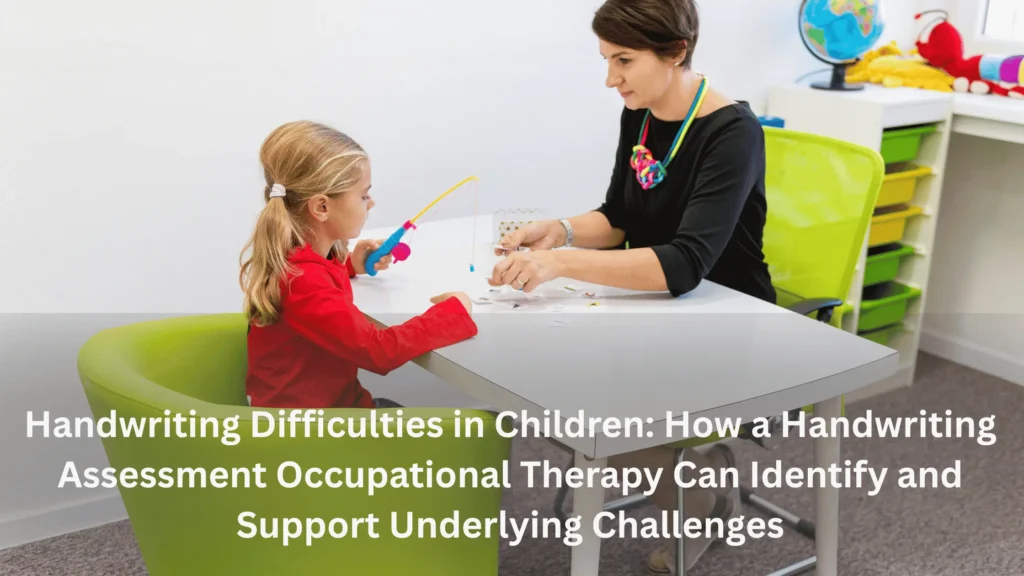
What Happens During a Handwriting Assessment Occupational Therapy Session?
A handwriting assessment with a paediatric OT is a thorough, structured process. Here is what families can expect at Wonder Kids OT:
Parent Interview and Developmental History:
The session typically begins with a conversation with parents about developmental history, school reports, any previous assessments, and the specific concerns that prompted the referral.
Handwriting Observation and Analysis:
The occupational therapist will observe your child writing in a naturalistic way, assessing letter formation, pencil grip, posture, writing speed, and the quality of output across different tasks.
Standardised Fine Motor Assessment:
Standardised tools measure hand strength, finger dexterity, and fine motor coordination in relation to age-matched norms. This helps identify specific areas of delay.
Visual Motor Integration Assessment:
Assessment tools evaluate how accurately your child can copy shapes, reproduce designs, and coordinate visual input with hand movements.
Sensory Considerations:
Where relevant, the OT will explore whether sensory processing differences are contributing to discomfort or avoidance around writing activities.
Recommendations and Treatment Planning:
Following the assessment, families receive a written report outlining findings, clinical recommendations, and an individualised support plan. This may include direct handwriting assessment occupational therapy sessions, a home programme, and strategies for the school environment.
Developing Handwriting Skills: Age-by-Age Expectations
Understanding typical handwriting development milestones helps parents identify when to seek support.
• Ages 2–3: Scribbling, circular marks, and imitating vertical lines
• Ages 3–4: Pre-writing strokes including horizontal lines, crosses, and diagonal lines
• Ages 4–5: Beginning letter-like forms, writing own name, basic shape drawing
• Ages 5–6: Most uppercase letters, simple words, increasing consistency
• Ages 6–7: Lowercase letters forming, basic sentence writing
• Ages 7–9: Fluent letter formation, consistent sizing, introducing joined writing
• Ages 9+: Automatised handwriting that allows cognitive focus on content
Developing Drawing and Handwriting Skills for Ages 3–5
The foundation for handwriting is laid well before a pencil is picked up. For preschool children, the priority is building the core and shoulder strength, hand and finger coordination, and visual perception skills that underpin future writing success.
Effective developing drawing and handwriting skills activities for young children include:
• Drawing large free-form shapes with crayons on big sheets of paper or a whiteboard
• Finger painting and sensory play to develop tactile awareness
• Threading beads and sorting small objects to build fine motor precision
• Playdough rolling, pinching, and squeezing to build hand strength
• Scissor cutting along simple lines to develop hand coordination
• Drawing on a vertical surface (easel or taped paper on a wall) to strengthen wrist extension
At this age, the developing drawing and handwriting skills emphasis should remain on exploration and play, not formal writing instruction.
Activities to Develop Handwriting Skills at Home
Parents can meaningfully support their child’s progress between therapy sessions with targeted home activities.
Fun Handwriting Activities Occupational Therapy Uses
Occupational therapists make handwriting practice engaging. Common clinic and home-based activities include:
• Tracing letters in a tray of sand or rice for multisensory reinforcement
• Writing with chalk on outdoor pavement to practise large letter movements
• Using a whiteboard with colourful markers to make practice feel less high-stakes
• Playdough letter sculpting to reinforce letter shapes through a different medium
• Drawing on vertical surfaces to promote wrist extension and shoulder stability
• Threading or lacing activities to develop the pincer grip used in writing
• Colouring within detailed boundaries to build pencil control
Occupational Therapy Activities for Handwriting in the Clinic
Therapist-guided sessions introduce more targeted interventions including:
• Handwriting Without Tears and other evidence-based programmes
• Fine motor circuits targeting grip strength, endurance, and dexterity
• Visual scanning and perceptual activities to support letter discrimination
• Sensory integration strategies to address tactile or proprioceptive barriers
• Goal-directed writing practice with systematic feedback
How to Help a Child With Handwriting Problems: Practical Parent Tips
Beyond handwriting assessment occupational therapy sessions, parents play a vital role. Here are evidence-informed strategies to support your child at home:
• Ensure your child is seated with feet flat on the floor and elbows at desk height
• Keep writing practice sessions short and positive — five minutes of focused effort is better than twenty minutes of frustration
• Provide a non-slip mat under paper to prevent sliding
• Try different pencil grip aids if your child finds them helpful, but consult your OT first
• Praise effort and process, not just the end result
• Communicate with your child’s teacher so strategies are consistent between home and school
• Avoid correcting every error — prioritise one focus at a time as directed by your OT
When Should Parents Seek a Handwriting Assessment?
Consider seeking a professional handwriting assessment if your child:
• Is significantly behind age-appropriate handwriting milestones
• Becomes frustrated, avoidant, or distressed during writing tasks
• Complains of hand or arm pain when writing
• Produces written work that does not reflect their verbal ability or knowledge
• Is struggling to keep up in the classroom due to slow writing speed
• Has received feedback from their teacher about handwriting or fine motor concerns
• Has a diagnosis of autism, dyspraxia, ADHD, or another condition associated with motor difficulties
Book a Handwriting Assessment in Melbourne
Wonder Kids OT provides specialist handwriting assessment and occupational therapy services for children aged three to twelve years across Melbourne and surrounding suburbs. Our handwriting assessment occupational therapy work with children and families to identify underlying challenges, build functional skills, and restore confidence in the classroom.
If you are concerned about your child’s handwriting, contact Wonder Kids OT today to discuss your child’s needs and book an assessment.
Frequently Asked Questions
Handwriting difficulties can stem from fine motor delays, visual motor integration challenges, hand strength deficits, sensory processing differences, motor planning difficulties, postural instability, or attention challenges.
Yes. Occupational therapy is the gold-standard intervention for handwriting difficulties in children. An OT addresses the underlying causes rather than just practising letter formation, leading to more meaningful and lasting improvements.
Not necessarily. Poor handwriting has many causes. Dysgraphia is a specific learning difficulty characterised by a significant discrepancy between written output and overall ability. A qualified OT can assess whether dysgraphia is present and recommend appropriate support.
By around age seven, most children produce reasonably consistent and legible writing. Legibility should continue to improve through primary school. If your child’s handwriting is notably difficult to read well into Year 2 or beyond, an assessment is worthwhile.
Key signs include persistent illegibility, writing avoidance, hand fatigue or pain, very slow writing speed, difficulty copying from the board, or written work that does not reflect the child’s verbal abilities.
The dynamic tripod and lateral tripod grips are both considered functional and efficient. The ‘best’ grip is one that allows comfortable, legible writing without fatigue. If a grip is causing problems, an OT can recommend appropriate modifications or grip aids.
It is a structured evaluation by a paediatric OT that examines handwriting output, pencil grip, posture, fine motor skills, visual motor integration, and sensory factors. The assessment results in a personalised report and treatment plan.
Wonder Kids OT provides specialist handwriting assessments for children across Melbourne and surrounding Victorian suburbs. Contact our team to discuss your child’s needs.